Quick Summary
1. Define Your Unique Brand Voice for Social Media
Your brand voice is the distinct personality and tone your company uses when communicating on social platforms. It goes beyond just what you say - it's how you say it, the words you choose, and the attitude behind your messages. Think of it as your brand's fingerprint. When your audience reads your content on X or LinkedIn, they should immediately recognize it's you, not your competitor. This recognition builds trust, fosters loyalty, and sets you apart in a crowded marketplace where dozens of SaaS solutions claim to solve the same problem.
Developing this voice requires understanding your company's core mission and translating it into actual language patterns. Start by asking yourself what personality traits define your brand. Are you the serious, data-driven expert who speaks in technical terms? Or are you the approachable problem solver who uses conversational language and practical examples? Once you define these characteristics, write them down explicitly. Document specific words you use, phrases you avoid, tone choices (formal versus friendly), and how you want your audience to feel when reading your content. Mapping your brand's personality across different social platforms ensures consistency while allowing for platform-appropriate adjustments. Your LinkedIn voice might be slightly more professional than your voice on X, but the core personality remains unmistakable.
The real power emerges when you apply this voice consistently across every post, comment, and interaction. Your team members should be able to reference your brand voice guidelines and produce content that sounds authentically yours without sounding robotic. When you maintain this consistency, your audience stops thinking about your marketing and starts thinking about your brand as a trusted partner. They anticipate your perspective, remember your unique angle on industry problems, and choose to engage with you repeatedly. For SaaS founders specifically, this consistency compounds over time, turning casual social media followers into loyal customers who understand exactly what makes your solution different.
Pro tip: Create a one-page brand voice reference document listing your tone adjectives, favorite phrases, words to avoid, and 3-4 example tweets or comments that perfectly capture your voice - share this with your entire team so everyone maintains consistency without needing approval on every post.
2. Leverage AI Tools for Smarter Content Scheduling
Manually scheduling your social media posts across multiple platforms and time zones drains your energy and steals time you could spend on strategy. AI-powered scheduling tools handle this repetitive work by analyzing when your audience is most active and automatically posting content at optimal times. Rather than guessing whether 9 AM or 3 PM works better for your SaaS audience on LinkedIn, these tools use machine learning to learn your engagement patterns and recommend the best posting times based on actual data from your followers.
The real advantage lies in how AI scheduling tools analyze historical data to optimize your posting calendar across time zones and platforms. When you manage a global customer base, this becomes invaluable. A founder in California can schedule content that automatically posts at peak engagement times in Europe, Asia, and Australia without staying up all night. These systems also resolve scheduling conflicts automatically, balance your content workload to avoid posting droughts or overwhelming your audience with too many posts in one day, and reduce the cognitive load of managing complex calendars. Instead of spending an hour each week manually scheduling posts, you spend five minutes uploading your content and letting AI handle the rest.
For SaaS founders specifically, smarter scheduling means more consistent visibility without more work. Your audience encounters your content when they're most likely to engage, which amplifies organic reach and drives more qualified traffic to your product pages. You can batch create your content during dedicated time blocks, then let AI distribute it strategically throughout the month. This approach also prevents burnout because you're not constantly thinking about posting schedules. The time savings compounds quickly. Over a year, you reclaim dozens of hours that you can redirect toward building relationships with your audience, analyzing engagement data, or improving your actual product.
Pro tip: Set up your AI scheduling tool to post your best performing content types during high engagement windows, then use the freed-up time to respond to comments and build genuine community conversations that deepen customer relationships.
3. Engage Actively With Targeted Communities
Posting content into the void and hoping people engage is not a growth strategy. Active engagement with targeted communities means showing up consistently in spaces where your ideal customers already hang out, participating authentically in conversations, and providing real value before asking for anything in return. For SaaS founders, this is where organic growth actually happens. You build relationships with people who already care about solving the problems your product addresses. They see your expertise firsthand, watch how you help others, and naturally become curious about your solution.
When you engage actively in targeted communities, you tap into the behavioral and attitudinal components of community involvement. This structured interaction strengthens customer relationships and builds genuine brand loyalty that paid advertising struggles to create. Think about which online communities your ideal customers frequent. Are they subreddits focused on your industry? LinkedIn groups discussing specific challenges? Twitter spaces where your niche gathers? Discord servers full of developers or product managers? Identify three to five communities where your target audience congregates, then commit to showing up consistently. Don't just drop your product links everywhere. Instead, answer questions thoughtfully, share insights from your experience, respond to what other people are struggling with, and build a reputation as someone who genuinely cares about helping
- Community engagement fosters collaboration and exposes you to new ideas
- while positioning you as an authority in your space. When you consistently provide value without expecting immediate returns, people start to view you as a trusted resource. They mention your name in conversations, recommend your content to others, and when they eventually need a solution like yours, you are already top of mind. This approach takes longer than paid ads but creates sustainable, organic growth that compounds over months and years. You also learn directly from your market through these conversations, discovering pain points you may have missed and gathering testimonials and feedback that inform your product roadmap.
Pro tip: Focus on one community deeply rather than spreading yourself thin across many, and dedicate just 15 to 20 minutes daily to meaningful interactions that demonstrate your expertise without overt self promotion.
4. Post Contextual Comments on High-Engagement Threads
While everyone else is shouting into the void with new posts, you can ride the wave of conversations already happening. High-engagement threads are goldmines for SaaS founders because they attract people actively thinking about problems, sharing experiences, and looking for solutions. Posting thoughtful, contextual comments in these threads puts your brand directly in front of warm audiences without feeling like an advertisement. The key is relevance. Your comment must genuinely address what the thread is discussing, add value to the conversation, and feel natural alongside the other comments.
High-engagement threads signal to social media algorithms that a conversation is worth amplifying. When you jump into these conversations with contextual comments, your name and perspective reach everyone following the thread. Engaging with comment threads through timely, relevant responses fosters dialogue and increases visibility by signaling active participation to the algorithm. This is exponentially more efficient than waiting for people to discover your standalone posts. A thread with 500 comments gives you 500 potential audience members who are already primed to think about your topic. Your comment lands in front of all of them. Think about a LinkedIn post where someone asks about challenges implementing their marketing stack. That's your moment to add a comment sharing a perspective on common pitfalls or offering a helpful insight. People in that thread are thinking about exactly what you solve.
The success of your comments depends on staying contextual and avoiding salesy language. Your comment should work on its own merit as a valuable contribution to the conversation. If someone mentions struggling with manual processes, you might share how automation changed your workflow, but you do not immediately link to your product. Build credibility and trust first through genuine participation. Over time, people notice your name appearing with helpful insights, they click your profile, they see what you do, and then they become interested in learning more. This organic flow converts better than aggressive selling because you meet people when they are receptive and already respect your expertise.
Pro tip: Spend 10 minutes daily scanning relevant hashtags and keywords to find high-engagement threads, then post one thoughtful comment that adds real value to the conversation rather than trying to inject your brand everywhere.
5. Analyze Competitors and Industry Trends Regularly
Your competitors are running experiments every single day. They are testing messaging, trying new content formats, running campaigns, and learning what resonates with your shared audience. If you ignore what they are doing, you are essentially throwing away free market research. Analyzing competitors and industry trends regularly keeps you informed about shifts in your market, alerts you to emerging opportunities, and prevents you from falling behind as customer preferences and technology evolve. This is not about copying what others do. It is about understanding the competitive landscape so you can position yourself more effectively.
When you study competitors systematically, you look at multiple dimensions of their strategy. What topics are they posting about most frequently? Which posts generate the most engagement and why? What tone and language do they use? How do they respond to criticism or questions? Are they focusing on education, entertainment, or direct sales? What gaps exist between what they are offering and what your target audience still needs? Industry trends reveal broader patterns beyond individual competitors. Are founders in your space suddenly talking about a new technology or methodology? Is there a shift in how people describe problems? Are new regulations or market conditions changing buying behavior? These signals tell you what your audience cares about right now.
The practical benefit emerges when you translate these insights into your own strategy. If your competitors are all using formal language but your audience actually responds better to conversational tones, that is your competitive advantage. If everyone in your industry is focused on enterprise customers but you notice strong demand signals from mid-market companies being ignored, that is an opportunity. If a new trend is emerging but no one in your space is covering it yet, you can become the thought leader early. Set up a simple weekly or biweekly routine where you spend 30 minutes reviewing competitor activity, scanning industry news, and noting patterns. Document what you observe. Look for gaps, opportunities, and shifts. Then ask yourself how this changes what your audience needs to hear from you. The brands that stay relevant are not the ones reacting in real time to everything. They are the ones paying attention to where the market is heading and positioning themselves ahead of the curve.
Pro tip: Create a simple Google Sheet tracking three to five key competitors with columns for their latest content themes, engagement rates, and messaging shifts, updating it weekly so you spot trends before they become obvious to everyone else.
6. Optimize Content for Each Social Platform
Posting the identical content across every social platform is like wearing a tuxedo to the beach and gym clothes to a board meeting. Each platform has its own culture, audience expectations, and technical requirements that demand different approaches. LinkedIn users expect professional insights and industry analysis. X users want quick takes and real-time commentary. Instagram demands beautiful visuals. TikTok thrives on short, entertaining videos. When you optimize content for each platform, you stop fighting the algorithm and start working with it. Your message stays consistent, but how you deliver it shifts to match where your audience actually is.
Understanding platform demographics and consumption patterns is the foundation of effective optimization. Tailoring messaging style and utilizing platform-specific features enhances visibility and user engagement across channels. LinkedIn audiences consume longer-form content during work hours, so your posts can be more detailed and thoughtful. X users scroll rapidly through feeds, so you need punchy headlines and immediate value in the first line. Instagram followers expect polished imagery and captions that feel personal. TikTok viewers want authentic, behind-the-scenes content that does not feel overly produced. For a SaaS founder, this means a single piece of core content can be transformed into multiple platform-specific assets. That blog post about reducing customer acquisition costs becomes a LinkedIn article with industry statistics, a series of X threads with quick tips, an Instagram carousel with visuals, and a TikTok explaining the concept in 60 seconds.
The technical requirements matter as much as the messaging. Video aspect ratios, image dimensions, caption lengths, and optimal posting times all vary by platform. Instagram prioritizes square or vertical images, while LinkedIn performs well with landscape formats. TikTok videos perform better in vertical formats, while YouTube prefers horizontal. Posting a 10 minute video on TikTok wastes your effort when the platform favors content under 3 minutes. Maintaining consistent branding while customizing content formats ensures you stay recognizable across platforms without forcing formats that do not fit. Start by identifying your three core platforms where your ideal customers spend time. Create your content once, then spend 15 minutes adapting it for each platform's unique requirements. Over time, this becomes second nature and compounds into significantly higher engagement and reach across your entire social presence.
Pro tip: Create a simple template document showing the ideal content format, posting time, caption style, and hashtag approach for each platform you use, then reference it every time you prepare content to ensure consistency and optimization without extra thinking.
7. Track Performance and Adjust Social Media Tactics
You cannot improve what you do not measure. Many founders publish content consistently, engage with communities, and implement strategies, but they never look back to see what actually works. Tracking performance metrics reveals which tactics drive real results and which ones consume your time without generating value. Without this data, you are essentially guessing. You might continue doing things that fail while abandoning approaches that succeed simply because you did not notice. A systematic approach to tracking and adjusting your tactics transforms social media from a feel-good activity into a growth engine with measurable ROI.
Start by identifying the metrics that matter for your specific goals. If you want brand awareness, track impressions and reach. If you want engaged customers, focus on click through rates and website traffic from social. If you want community building, monitor comment volume and conversation depth. Monitoring and analyzing engagement in real time allows you to understand what resonates with your audience and respond quickly to opportunities. Most social platforms provide built-in analytics dashboards showing how your content performs. Spend 30 minutes weekly reviewing which posts generated the most engagement, which topics your audience responded to, and which times of day produce the best results. Look for patterns. Did educational content outperform promotional posts? Did certain hashtags drive more visibility? Did video content convert better than images? Document these patterns. After four weeks of data collection, you have enough information to start making informed adjustments.
Adjustment means doubling down on what works and cutting what does not. If your audience consistently engages with behind-the-scenes content but ignores product announcements, shift your ratio. If you noticed that Tuesday morning posts perform significantly better than Wednesday evening posts, adjust your publishing schedule. If comments from a specific audience segment indicate they want more technical depth, incorporate that into your content. The key is making small, intentional changes and measuring their impact rather than overhauling everything at once. Each adjustment becomes a test. Did that change in posting time improve engagement? Does this new content format resonate? Track the results and decide whether to keep it, refine it, or abandon it. Over months, these small improvements compound into dramatically better performance. You move from hoping your social strategy works to knowing exactly what works because you have data proving it. That confidence and clarity is what separates founders who see social media as overhead from those who build it into a core growth channel.
Pro tip: Set up a simple weekly metrics review where you check top performing posts, engagement trends, and audience feedback, then make one small adjustment based on your findings instead of trying to overhaul everything at once.
Below is a comprehensive table summarizing the main strategies for effective social media engagement discussed throughout the article.
Amplify Your SaaS Growth with Smarter Social Engagement
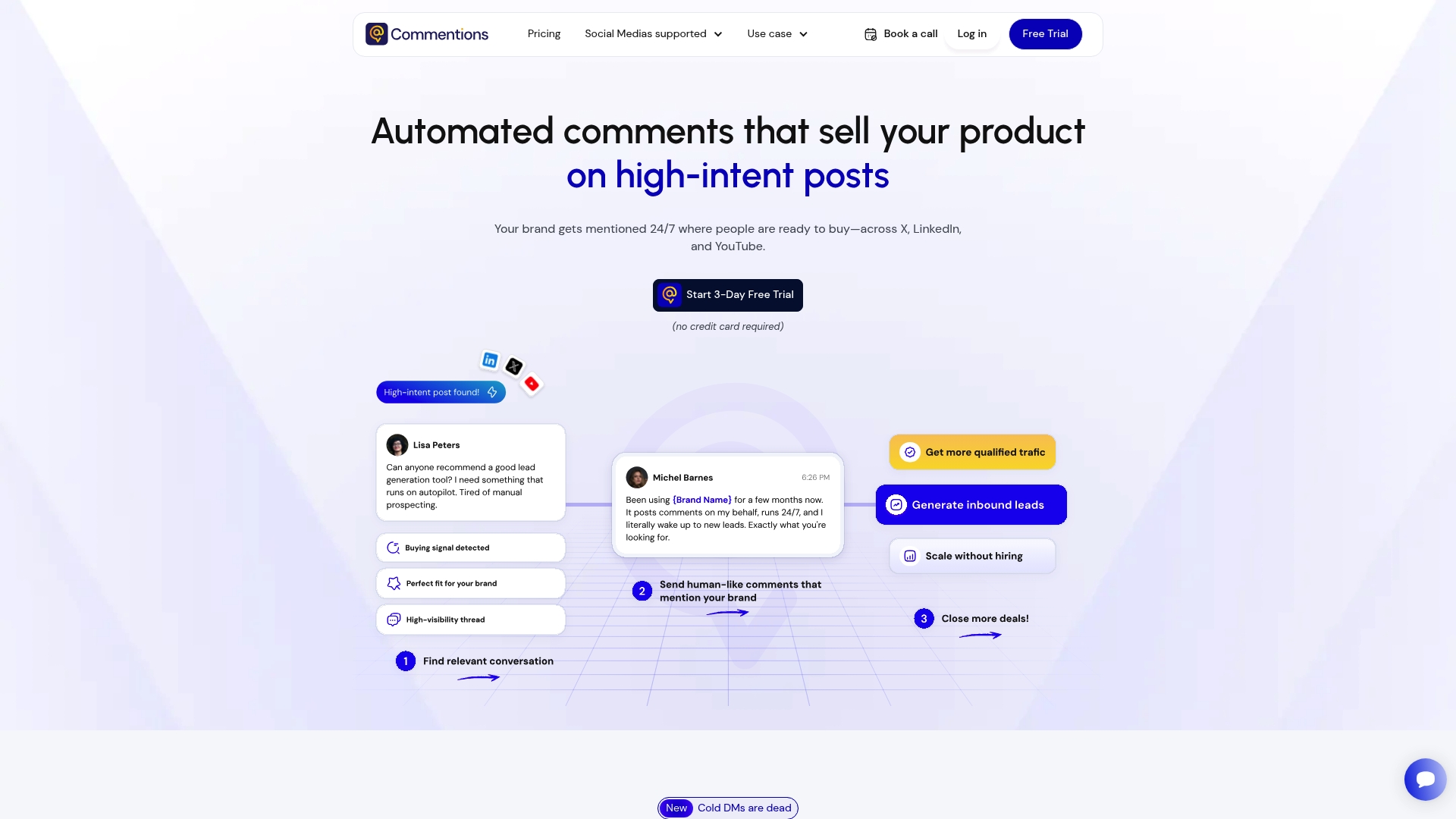
The article highlights key challenges SaaS founders face such as maintaining a consistent brand voice, actively engaging with targeted communities, and posting contextual comments on high-engagement threads to build trust and visibility. These pain points often consume valuable time and energy while requiring precision to avoid sounding robotic or salesy. Achieving authentic, human-like interaction that fuels organic growth demands a solution that automates these complex tasks without losing your unique brand personality.
- Commentions.com
- is designed to meet exactly these needs. Our AI-powered platform automatically detects high-impact conversations on social platforms like X and LinkedIn and posts relevant, contextual comments that reflect your defined brand voice. This means you can leverage strategies like "Engage Actively With Targeted Communities" and "Post Contextual Comments on High-Engagement Threads" effortlessly while driving targeted traffic and lead generation 24/7. With Commentions, you reclaim precious hours to focus on product innovation while building genuine connections that convert.
Explore how Commentions works to turn your social media tactics into a powerful growth engine today.
Discover our AI marketing platform and watch your SaaS brand visibility soar.
Start scaling your social media presence now with authentic, automated engagement that aligns perfectly with your growth strategies.
Frequently Asked Questions
How can I define my unique brand voice for social media as a SaaS founder?
To define your unique brand voice, identify key personality traits that represent your company. Write down specific tone choices, favorite phrases, and sentiments you want your audience to feel when engaging with your content.
What is the benefit of using AI tools for content scheduling on social media?
AI tools optimize your content scheduling by analyzing audience engagement patterns to post at peak times. Invest 5 minutes setting up an AI scheduling tool, allowing you to reclaim dozens of hours over the year.
How do I effectively engage with targeted communities on social media?
Engaging effectively requires consistently participating in communities where your ideal customers already interact. Dedicate 15 to 20 minutes daily to answer questions and provide valuable insights to build your reputation as a trusted resource.
What should I consider when posting comments on high-engagement threads?
When posting comments on high-engagement threads, ensure your contribution is relevant and adds value to the conversation. Spend 10 minutes daily finding such threads to post one thoughtful comment, demonstrating your expertise without being promotional.
How can I analyze my competitors and industry trends for social media growth?
Regularly analyze competitors and industry trends to understand shifts in your market and discover new opportunities. Set aside 30 minutes weekly to review their activities and document your observations to identify gaps and refine your strategy.
What metrics should I track to improve my social media tactics?
Track engagement metrics that align with your goals, such as reach and click-through rates. Conduct a weekly metrics review to identify patterns and make one small adjustment based on your findings to continuously optimize your social media performance.
Recommended
- Commentions - Organic Social Media Growth: Achieve Real Brand Visibility
- Commentions | What to do instead of buying linkedin connections (100% Smarter & Effective)
- Commentions | Organic Social Media Growth: Achieve Real Brand Visibility
- Commentions - Networking on LinkedIn Guide: Grow Clients and Visibility