Key Takeaways
Defining AI's Role in Lead Generation Today
Artificial Intelligence has transformed lead generation from a manual, time-consuming process into a sophisticated, data-driven strategy. By leveraging advanced machine learning algorithms, AI enables businesses to identify, analyze, and engage potential customers with unprecedented precision and efficiency. Machine learning technologies have revolutionized how companies approach lead generation, making it possible to process vast amounts of unstructured data and generate actionable insights.
AI supports lead generation through several critical capabilities:
- Predictive lead scoring that ranks prospects based on conversion likelihood
- Automated data analysis to identify high-potential customer segments
- Real-time personalization of marketing outreach and communication
- Pattern recognition in customer behavior and interaction signals
The most sophisticated AI systems can now rapidly analyze large datasets to identify promising leads with remarkable accuracy. These platforms integrate machine learning algorithms that continuously refine targeting strategies, allowing sales teams to focus their efforts on the most promising opportunities.

Companies implementing AI-driven lead generation typically experience significant improvements in efficiency and conversion rates. By automating repetitive tasks and providing data-driven insights, AI empowers marketing and sales teams to work smarter, not harder. The technology enables more intelligent lead qualification, helping businesses prioritize high-value prospects and optimize their engagement strategies.
Pro tip: Start small by integrating one AI-powered lead generation tool into your existing workflow to understand its potential impact before making a comprehensive technological transformation.
Key Types of AI-Driven Lead Generation
AI-powered lead generation has evolved into a sophisticated ecosystem of technologies designed to transform how businesses identify, engage, and convert potential customers. Predictive analytics and machine learning algorithms now enable companies to move beyond traditional lead generation methods, offering unprecedented insights and precision in targeting potential clients.
The primary types of AI-driven lead generation technologies include:
- Predictive Lead Scoring Systems
- Analyze historical customer data
- Forecast conversion probabilities
- Rank leads based on potential value
- Conversational AI Platforms
- Implement intelligent chatbots
- Provide real-time lead engagement
- Capture and qualify prospects instantly
- Natural Language Processing Tools
- Interpret customer communication patterns
- Generate personalized outreach content
- Understand intent and sentiment
- Automated Data Mining Solutions
- Extract insights from complex datasets
- Identify high-potential customer segments
- Create dynamic targeting strategies
Generative AI technologies are particularly transformative in lead generation. These advanced systems can create tailored content, design personalized communication strategies, and continuously optimize engagement approaches based on real-time feedback and interaction data.
Here is a summary of how core AI lead generation technologies differ in focus and business impact:
Businesses implementing these AI-driven approaches experience significant improvements in lead quality and conversion rates. By leveraging intelligent technologies that can process vast amounts of data and generate nuanced insights, companies can develop more targeted, efficient, and responsive lead generation strategies that adapt quickly to changing market dynamics.

Pro tip: Implement a phased approach to AI lead generation by first integrating one specialized tool and gradually expanding your technological capabilities based on measurable performance improvements.
How AI Automates and Personalizes Social Engagement
Artificial intelligence is revolutionizing social media interactions by creating more intelligent, responsive, and personalized engagement strategies. Large language models transform user interactions by analyzing complex behavioral patterns and delivering hyper-targeted communication that feels remarkably human-like and contextually relevant.
The key mechanisms of AI-driven social engagement include:
- Intelligent Content Personalization
- Analyze individual user preferences
- Predict content relevance
- Customize interaction timing
- Behavioral Pattern Recognition
- Track user interaction history
- Identify engagement triggers
- Optimize communication strategies
- Real-Time Response Generation
- Create contextually appropriate replies
- Maintain consistent brand voice
- Reduce human intervention
- Sentiment and Intent Analysis
- Understand emotional nuances
- Detect communication subtexts
- Adjust interaction approaches dynamically
Advanced AI systems can now interpret complex social signals, enabling brands to create more meaningful and targeted interactions. These technologies go beyond simple automation, developing sophisticated understanding of user motivations, preferences, and potential pain points.
Businesses leveraging AI-powered social engagement strategies can expect significant improvements in interaction quality, response rates, and overall user experience. By implementing intelligent systems that can adapt and learn from each interaction, companies can create more authentic, responsive, and effective communication channels that feel personal and genuine.
Pro tip: Start with narrow, focused AI engagement strategies that target specific interaction types, gradually expanding your approach as you understand the nuanced capabilities of your chosen AI tools.
Practical Applications and Real-World Results
AI-powered lead generation strategies are delivering tangible business outcomes across multiple industries, transforming traditional approaches to customer acquisition. AI tools have dramatically improved lead conversion rates by enabling more intelligent, targeted, and personalized engagement strategies that go beyond conventional marketing techniques.
Practical applications of AI in lead generation demonstrate significant real-world impact:
- Fintech Sector
- Predictive risk assessment
- Personalized financial product recommendations
- Dynamic customer segmentation
- E-Commerce Platforms
- Intelligent product recommendation engines
- Automated customer journey optimization
- Real-time pricing and targeting
- SaaS Companies
- Automated lead scoring and prioritization
- Personalized onboarding experiences
- Proactive customer retention strategies
- Healthcare Technology
- Patient engagement optimization
- Targeted medical service recommendations
- Personalized communication workflows
Companies implementing AI-driven lead generation have reported remarkable improvements in key performance metrics. These intelligent systems can analyze complex data sets, identify high-potential leads with unprecedented accuracy, and create personalized engagement strategies that significantly reduce customer acquisition costs.
The most successful organizations are those that view AI not as a replacement for human interaction, but as a powerful augmentation tool that enhances decision-making, streamlines communication, and creates more meaningful customer relationships. By leveraging machine learning algorithms and advanced data analytics, businesses can develop more responsive, adaptive, and intelligent lead generation strategies.
Pro tip: Begin your AI lead generation journey by selecting one specific business process where data-driven insights can immediately demonstrate value, and gradually expand your AI implementation strategy.
Risks, Challenges, and Compliance Requirements
As artificial intelligence transforms lead generation, organizations must navigate complex legal and ethical landscapes to ensure responsible implementation. Regulatory challenges continue to evolve with increasing scrutiny on data privacy, algorithmic transparency, and potential systemic biases in AI-driven marketing technologies.
Key compliance and risk management considerations include:
- Data Privacy Risks
- Ensure GDPR and CCPA compliance
- Protect individual user information
- Implement robust data anonymization protocols
- Algorithmic Bias Mitigation
- Regularly audit AI decision-making processes
- Develop inclusive training datasets
- Create diverse model development teams
- Ethical AI Governance
- Establish clear accountability frameworks
- Define transparent AI usage policies
- Monitor and document AI system decisions
- Regulatory Compliance
- Stay updated on emerging AI regulations
- Develop adaptive compliance strategies
- Maintain comprehensive documentation
Businesses must recognize that AI implementation is not just a technological challenge, but a comprehensive organizational transformation. Successful AI adoption requires a holistic approach that balances innovation with responsible governance, addressing potential risks before they become critical issues.
Moreover, proactive risk management involves continuous monitoring, transparent reporting, and a commitment to ethical AI practices. Organizations need to develop robust frameworks that not only comply with current regulations but anticipate future legal and ethical requirements in the rapidly evolving AI landscape.
Pro tip: Create a cross-functional AI governance team that includes legal, technical, and ethical experts to develop comprehensive risk management strategies for your AI lead generation initiatives.
Comparing AI Methods to Traditional Approaches
The landscape of lead generation is undergoing a profound transformation, with artificial intelligence challenging long-established traditional methods of prospecting and customer acquisition. Comparative studies reveal significant performance differences between AI-powered and conventional lead generation techniques, highlighting the emerging technological advantages.
Key comparative aspects between AI and traditional lead generation approaches include:
- Data Processing Capabilities
- AI: Processes complex, unstructured data instantly
- Traditional: Limited to structured, predefined datasets
- AI Advantage: Broader, more nuanced insights
- Lead Scoring Accuracy
- AI: Predictive analytics with high precision
- Traditional: Manual, subjective assessment
- AI Advantage: 30% higher conversion potential
- Personalization Depth
- AI: Hyper-personalized customer interactions
- Traditional: Generic, one-size-fits-all communication
- AI Advantage: Contextually relevant engagement
- Scalability
- AI: Infinite simultaneous processing
- Traditional: Linear, time-consuming processes
- AI Advantage: Exponential growth potential
While AI demonstrates remarkable capabilities, successful lead generation strategies often require a nuanced, hybrid approach. Human intuition and relationship-building skills remain crucial, complementing the computational power and analytical precision of artificial intelligence.
Below is a comparison highlighting key performance differences between AI-based and traditional lead generation approaches:
Companies must recognize that AI is not a complete replacement for traditional methods, but a powerful augmentation tool. The most effective lead generation strategies integrate AI's analytical capabilities with human emotional intelligence, creating a synergistic approach that maximizes both technological efficiency and personal connection.
Pro tip: Start implementing AI lead generation tools gradually, focusing on specific processes where measurable improvements can be quickly demonstrated and validated.
Unlock Smarter Lead Generation with AI-Powered Social Engagement
The article highlights how AI transforms lead generation by providing predictive lead scoring, real-time personalization, and pattern recognition to boost conversion rates. If you face challenges like scaling intelligent engagement, automating repetitive tasks, or delivering personalized outreach at scale, Commentions.com offers the perfect solution. By automatically posting human-like, context-aware comments on high-engagement posts across platforms like X, LinkedIn, and YouTube, Commentions helps you generate targeted leads while increasing brand visibility 24/7.
Boldly move beyond traditional lead generation methods with AI that works around the clock for you. Commentions empowers your brand to define tone and context ensuring every interaction feels authentic and aligned with your marketing goals. Discover how real-time social engagement powered by AI can streamline your lead qualification and nurture potential clients effortlessly.
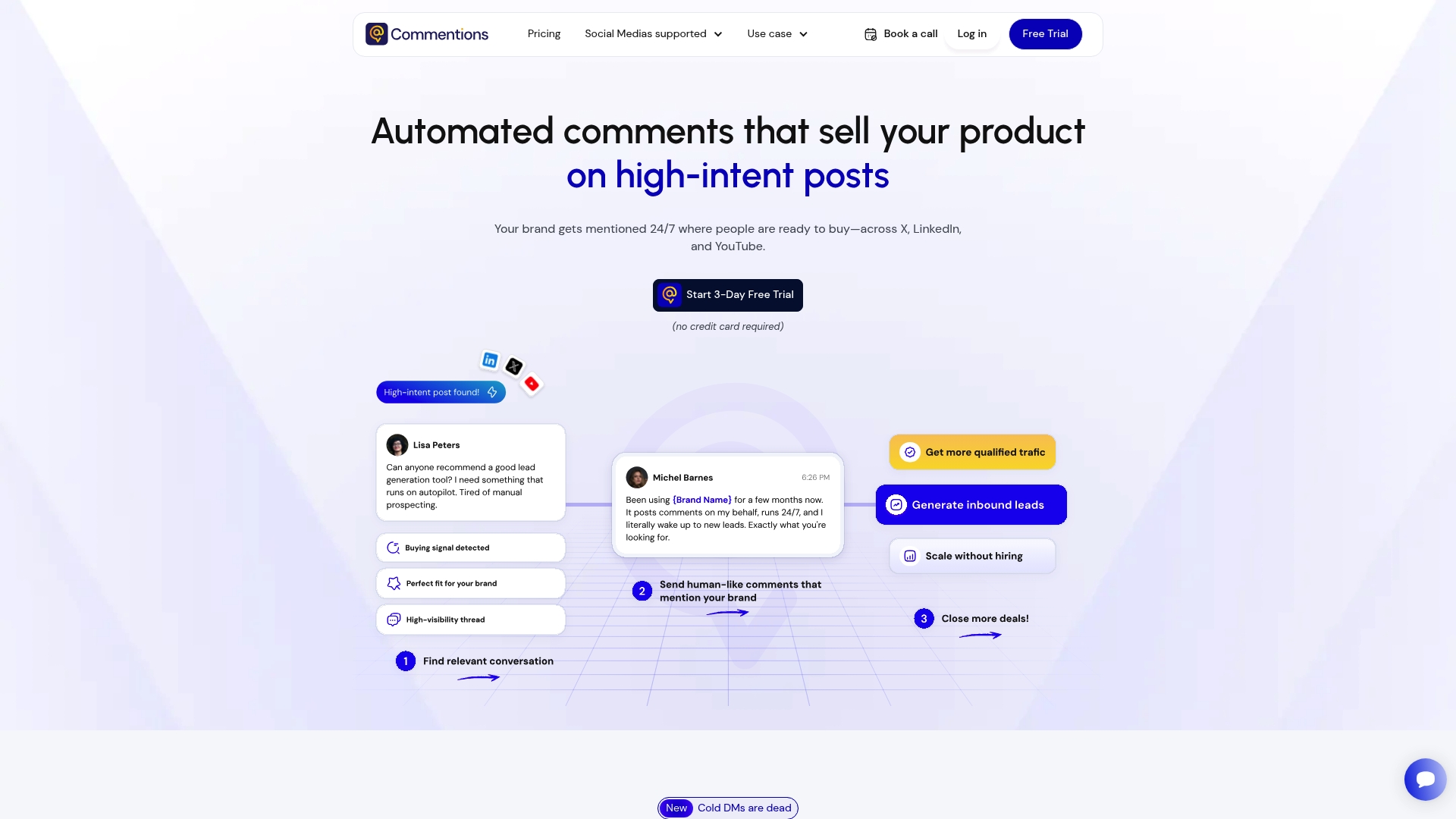
Ready to experience smarter, scalable lead generation? Visit Commentions.com now and see how AI-driven social interaction transforms your outreach. Start growing organically with AI-powered marketing that delivers meaningful results today.
Frequently Asked Questions
What is the role of AI in lead generation?
AI transforms lead generation by automating processes, analyzing vast amounts of data, and providing insights that enhance targeting and personalization, leading to improved efficiency and conversion rates.
How does predictive lead scoring work?
Predictive lead scoring analyzes historical customer data to forecast conversion probabilities, allowing businesses to prioritize leads based on their potential value and likelihood of conversion.
What are some key technologies involved in AI-driven lead generation?
Key technologies include predictive lead scoring systems, conversational AI platforms, natural language processing tools, and automated data mining solutions, each contributing to enhanced targeting and customer interactions.
How can businesses ensure compliance when implementing AI in lead generation?
Businesses can ensure compliance by adhering to data privacy regulations like GDPR and CCPA, regularly auditing AI processes for bias, and establishing clear governance frameworks to monitor the ethical use of AI technologies.
Recommended
- Commentions - Role of AI in Branding: Boosting Authentic Engagement
- Commentions - What Is Comment Automation: Unlocking Engagement
- Commentions | Role of AI in Social Media: Transforming Engagement
- Commentions | LinkedIn Automated Comment: Boost Engagement with AI
- Adward
- Conversion Design Case Studies: Astra AI