Key Takeaways
What Commenting Workflow Means In Marketing
A commenting workflow is a systematic approach to managing how your brand engages with audiences across social platforms through strategic, authentic comments. Think of it as the backbone of your social media engagement strategy, where every interaction follows a deliberate sequence designed to build relationships rather than broadcast messages. At its core, a commenting workflow defines the steps your team takes from identifying valuable conversations to crafting responses that feel genuine and aligned with your brand voice.
In practical terms, a commenting workflow represents structured steps for handling customer comments and engagements efficiently, moving from discovery of relevant posts through review, response, and analysis of results. For small business founders and freelancers, this means you're not randomly commenting on posts hoping something sticks. Instead, you're following a repeatable process that ensures each comment you leave serves a purpose, whether that's driving traffic, establishing authority, or generating leads. Your workflow might include steps like identifying posts in your industry niche, researching the poster's audience, writing comments that add genuine value, and tracking which comments drive meaningful traffic back to your business.
What makes this different from traditional marketing is that commenting workflows operate as part of a broader engagement strategy that drives organic growth. Rather than pushing sales messages, you're inserting your brand into conversations where your ideal customers are already talking. The workflow ensures consistency, authenticity, and measurable results. Without a defined workflow, commenting becomes haphazard and time-consuming. With one in place, you can scale your engagement efforts while maintaining the personal touch that makes audiences actually care about what you're saying. This is especially valuable for freelancers juggling multiple client projects and small business owners stretched thin across endless tasks.
Pro tip: Start by mapping out your commenting workflow on paper or in a simple spreadsheet, defining exactly who identifies posts, how comments get approved before posting, and what metrics you'll track to measure impact.
Main Types Of Commenting Workflows Explained
Not all commenting workflows are created equal. Depending on your business goals, audience, and resources, you'll choose different approaches to manage how comments flow through your marketing funnel. Understanding these types helps you pick the strategy that matches your brand's personality and engagement goals.

The most common commenting workflows break down into three main categories. Open commenting workflows let anyone comment without restrictions or approval processes, creating maximum engagement but requiring constant monitoring for spam or off-topic posts. Moderated commenting workflows involve either pre-approval (comments reviewed before posting) or post-approval (comments published then reviewed), giving you control over quality while maintaining a professional environment. Registered user workflows require people to create accounts or have established credentials before commenting, which dramatically reduces spam and increases accountability among participants. Each of these represents a different balance between openness and control. Different commenting workflows impact user participation and comment quality, so your choice directly shapes the type of conversations happening around your brand.
For freelancers and small business founders using commenting as a marketing strategy, you're likely working with a hybrid approach. You might use open commenting on LinkedIn where your network already has some credibility, while employing moderation practices for quality control when commenting on high-traffic industry posts where you're establishing authority. Some founders use automated workflows that pre-screen comments for relevance and brand alignment before they're published, while others manually review and approve each one to ensure authenticity. The workflow you adopt depends on your bandwidth, audience expectations, and how critical brand reputation is in your industry. A software company might need strict moderation to prevent spam, while a creative agency might thrive with more open, conversational interactions that showcase personality and genuine engagement with their community.
Here's a comparison of main commenting workflow types and their business impacts:
Pro tip: Choose your workflow based on where your ideal customers actually comment, not where you think they should be, then test different approval processes for two weeks to see which generates the highest quality leads.
How AI Tools Automate Engagement Efficiently
Manually commenting on dozens of posts every week eats time you don't have. This is where AI-powered commenting tools solve a real problem for busy founders and freelancers. Instead of spending hours crafting individual comments, you define your brand voice and values once, then let AI handle the repetitive work of identifying relevant conversations and generating contextual responses that feel authentic to your audience.
AI tools streamline your commenting workflow by handling several critical tasks simultaneously. They scan social platforms in real-time for posts matching your industry, audience, or keywords. The system analyzes each post's content and engagement level, then AI can suggest conversation starters that increase engagement while reducing the barriers to consistent participation. Instead of starting from zero each time, you get intelligent suggestions that you can refine, approve, or customize before posting. For a freelance consultant juggling five clients, this means spending 30 minutes daily on commenting instead of three hours. The tool handles discovery and drafting, freeing you to focus on quality and strategy. Additionally, AI systems can assist with automated comment generation and personalized interactions, ensuring consistency across platforms while maintaining the personal touch that actually converts engagement into relationships.
The key to using AI effectively is setting clear parameters around authenticity. You're not trying to replace genuine human voice with robotic responses. Instead, you're using AI to amplify what you already do well and scale it beyond what's humanly possible alone. You tell the AI your brand values, your target audience characteristics, and the types of conversations that matter for your business. It learns your tone and style, then suggests comments that sound like you, not like a chatbot. Some founders use AI to generate three comment options for each post, then pick the one that feels most genuine. Others let the AI post directly but review metrics weekly to ensure engagement quality remains high. The role of AI in social media engagement is expanding specifically because done right, it enhances authenticity instead of replacing it.
Pro tip: Set up your AI tool with 3-5 sample comments you've written yourself, then let it train on your voice for one week before full automation, testing engagement quality closely before scaling up.
Traits Of Effective, Authentic Comments
Not every comment drives results. The difference between a comment that gets ignored and one that starts meaningful conversations comes down to specific traits that make your voice stand out. When you understand what makes a comment actually work, you can apply those principles consistently across every platform where you're trying to build your brand.
Effective authentic comments share several defining characteristics. Relevance matters first. Your comment must directly address what the original post discusses, not just mention your business tangentially. Specificity separates generic comments from ones that show you actually read the content. Instead of "Great post," you might say "Your point about reducing friction in onboarding reminds me of a challenge our clients faced last month." Respect and tone set the foundation for dialogue. Even when disagreeing, effective comments acknowledge the poster's perspective before adding your viewpoint. Clear language ensures people actually understand what you're contributing. Avoid jargon specific to your industry unless you know your audience speaks that way. Research on comment quality shows that traits including respectful language, interaction, and coherence define effective engagement, and these traits build community trust while reducing conflict that kills engagement.
Authenticity runs deeper than just sounding genuine. It means your comment reflects actual experience or informed perspective rather than marketing fluff. When someone reads your comment, they should believe you actually care about the topic, not just promoting your freelance services or product. This is where many founders trip up. They comment to get visibility, but audiences detect insincerity immediately. The most effective strategy is to comment on posts where you genuinely have something valuable to add. You might not comment on every post in your feed, but when you do, it comes from a place of real interest. Authentic comments demonstrate mutual recognition and foster trust through meaningful interaction, which converts casual engagement into actual relationships with potential clients or collaborators.
For your workflow, this means building evaluation into your commenting process. Before posting, ask yourself: Does this add information or perspective the poster or readers don't already have? Would I write this comment if no one knew it was from me? Does it sound like me, or like marketing copy? If you're hesitating on authenticity, that hesitation is usually right. Save the comment as a draft, revisit it tomorrow, and revise it to feel more genuine. How to craft authentic comments naturally becomes easier when you treat each comment as a mini opportunity to build authority through real contribution rather than visibility seeking.

Use this table to evaluate the impact of effective commenting traits on marketing outcomes:
Pro tip: Before hitting publish, read your comment out loud. If it sounds like you're talking to a friend in your industry, it probably hits the authenticity mark. If it sounds like marketing copy, rewrite it.
Biggest Mistakes And How To Avoid Them
Your commenting workflow can either build your brand or tank it. The difference often comes down to avoiding predictable mistakes that damage trust and visibility. Understanding what goes wrong helps you catch errors before they cost you engagement and credibility.
The first major mistake is commenting without reading. You scan a headline, see it's in your industry, and immediately leave a comment that has nothing to do with the actual post. This signals to both the original poster and readers that you're just chasing visibility. Similarly, spamming the same comment across multiple posts makes you look lazy and inauthentic. Each comment should address the specific post and conversation. Another critical error is ignoring or neglecting timely responses. If someone replies to your comment, responding within hours matters far more than leaving comments on ten other posts. You're building relationships, not a comment count. Common mistakes in online comment moderation include neglecting timely responses and inconsistent enforcement of community standards, which erode trust and reduce authentic engagement across your entire commenting program.
The second category of mistakes involves tone and approach. Being argumentative or dismissive poisons the well quickly. Even if someone gets facts wrong, you can correct them respectfully. Self-promotion disguised as helpful comments gets called out immediately. Readers can smell marketing language from a mile away. Controversial comments designed purely for attention might generate engagement short term but damage your brand long term. One harsh comment can undo weeks of authentic engagement work. Additionally, systemic issues like unchecked incivility and lack of effective moderation strategies reduce discourse quality and push away the serious participants you actually want in your community. This is why having clear guidelines for your own commenting matters.
Avoid these mistakes by establishing a simple pre-post checklist. Before commenting, ask yourself: Did I actually read the full post? Is this comment relevant to what they wrote? Does it add perspective or information? Would I be proud to have this represent my brand? If you're using AI to assist commenting, review every suggested comment before posting and apply the same standards. Track which comments generate genuine responses versus which ones fall flat. This data tells you what's working. Most importantly, treat commenting as a listening activity first. Spend time actually engaging with other people's ideas before pushing your own agenda.
Pro tip: Create a simple checklist of your top three commenting mistakes from the past month, then review each draft comment against that checklist before posting for the next 30 days.
Elevate Your Commenting Workflow With AI-Powered Authentic Engagement
Struggling to maintain an authentic commenting workflow that actually drives leads and grows your brand organically The article highlights how consistency, relevance, and genuine interaction are key challenges for freelancers and small business founders tapping social media. You want to invest less time while still posting comments that build trust and spark valuable conversations. Commentions.com answers this need by automating your commenting with AI that understands your brand voice and audience context. This means no more random, impersonal responses or laborious manual scheduling.
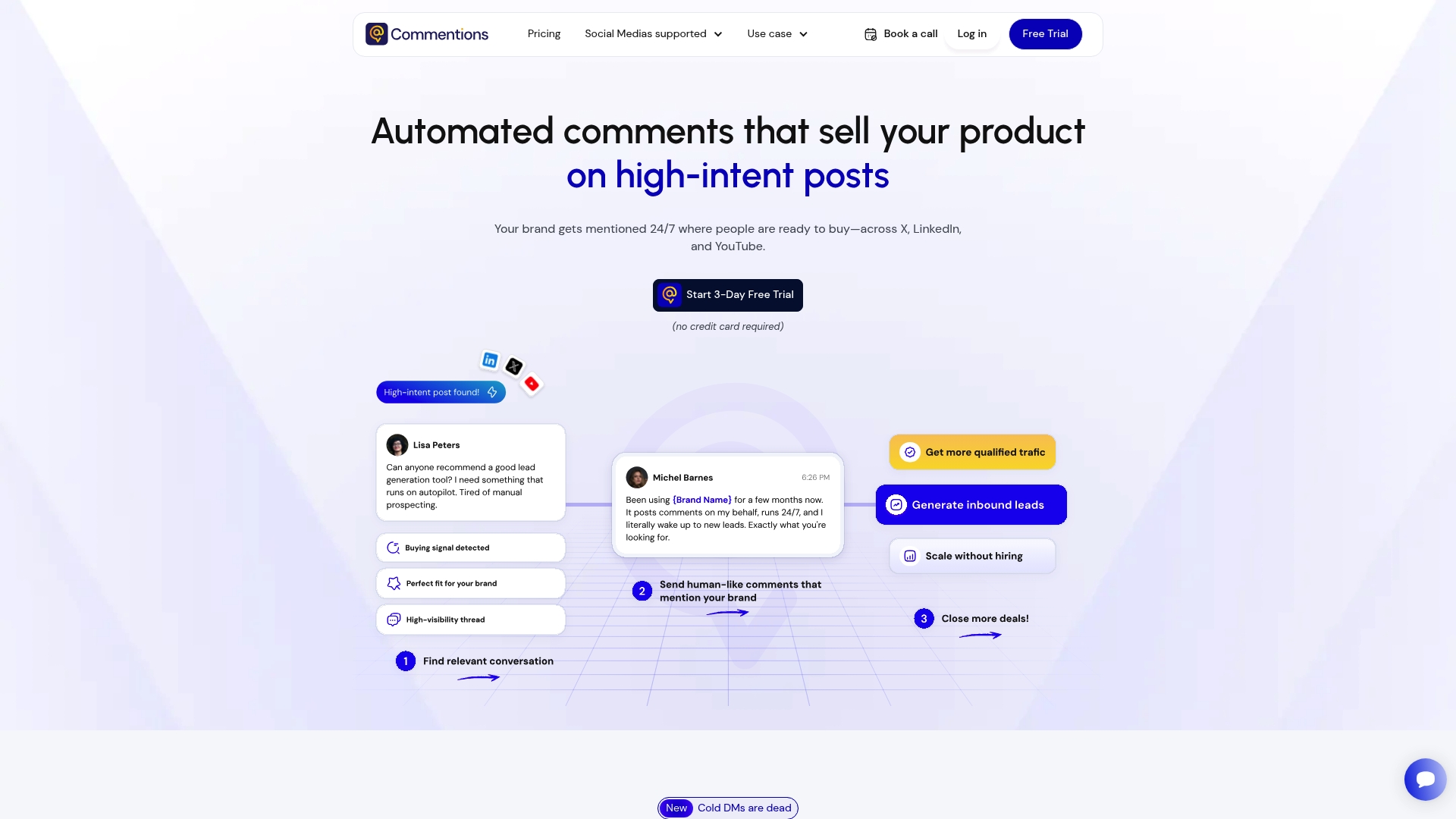
Discover how Commentions can streamline your commenting workflow by identifying high-engagement posts and crafting human-like comments tailored for platforms like LinkedIn, YouTube, and X. With full control over tone and brand alignment you stay authentic while scaling outreach effortlessly. Ready to stop wasting time and start converting engagements into real visibility and leads Visit https://commentions.com now and transform how your brand participates in conversations. Learn more about building effective workflows that integrate perfectly with our AI solutions on our main landing page. Your next authentic connection is just a comment away.
Frequently Asked Questions
What is a commenting workflow in marketing?
A commenting workflow is a systematic approach that guides how a brand engages with audiences on social media by managing comments strategically to build relationships and enhance engagement.
How can a commenting workflow affect my brand's visibility?
A well-defined commenting workflow enhances your brand's visibility by ensuring that relevant, authentic comments are made in conversations where your ideal customers are active, which can drive organic growth.
What are the main types of commenting workflows?
The main types of commenting workflows include open commenting (unrestricted), moderated commenting (pre- or post-approval), registered user workflows (users must create accounts), and hybrid models combining elements of each.
How does AI contribute to an effective commenting workflow?
AI tools automate the engagement process by identifying relevant posts and generating authentic comments based on your brand voice, which saves time and helps maintain consistency in interactions.
Recommended
- Commentions | Role of Comments in Engagement: Driving Organic Growth
- Commentions | Creating Engaging Comments Naturally for Maximum Impact
- Commentions | How to Craft Authentic Comments That Boost Engagement