.svg)
.webp)
.webp)


Nearly every American entrepreneur and marketer faces a hidden challenge when building their brand’s online presence. Without a clear brand personality, even the smartest automated social interactions can come across as generic and forgettable. Brands that embrace distinct human-like traits see up to 30 percent higher customer engagement than those relying on bland, robotic messaging. Discover how defining your brand personality leads to deeper connections and lasting authenticity in all your automated social media conversations.
| Point | Details |
|---|---|
| Brand Personality is Key | It embodies human-like traits that help brands connect emotionally with consumers, influencing their perceptions and loyalty. |
| Five Core Traits | Brands typically embody sincerity, excitement, competence, sophistication, or ruggedness, which can be strategically leveraged for authenticity. |
| Consistency is Crucial | Maintaining a consistent brand voice across all communications ensures a coherent representation of the brand’s personality. |
| Avoid Common Mistakes | Inconsistent messaging and a failure to align with core values can undermine brand personality, so regular audits are essential for authenticity. |
Brand personality represents the human-like characteristics and emotional attributes that define how a brand communicates, connects, and resonates with its target audience. Just as individuals have unique personalities that shape their interactions, brands develop distinctive traits that help them stand out in competitive markets. A comprehensive scholarly review reveals that brand personality goes far beyond simple marketing tactics — it’s a strategic framework for building meaningful consumer relationships.
At its core, brand personality transforms abstract business entities into relatable, memorable characters with specific emotional qualities. Imagine a brand as a person walking into a room: some brands might feel confident and professional, while others appear friendly and approachable. These personality dimensions directly influence consumer perceptions, purchasing decisions, and long-term brand loyalty. Research exploring brand identity development demonstrates that successful brands strategically craft personality traits that align with their target audience’s psychological and emotional needs.
The key components of brand personality typically include traits like sincerity, excitement, competence, sophistication, and ruggedness. Startup founders and freelance marketers can leverage these dimensions to create authentic, compelling brand narratives that differentiate them from competitors. By consistently expressing a well-defined personality across communication channels, brands can:
Pro tip: Conduct a comprehensive audience persona workshop to identify the precise personality traits that will most effectively resonate with your specific target market.
A foundational research framework identifies five core dimensions that comprehensively capture brand personality across diverse markets. These dimensions serve as a strategic blueprint for startup founders and marketers seeking to craft distinctive, memorable brand identities. Understanding these personality types allows businesses to create nuanced, emotionally resonant brand personas that connect authentically with target audiences.
The five key brand personality traits include:
Sincerity: Characterized by qualities like honesty, warmth, and genuineness. Brands embodying sincerity often appear down-to-earth, transparent, and trustworthy. Think of companies that prioritize customer care and demonstrate consistent ethical behavior.
Excitement: Represented by energetic, adventurous, and imaginative characteristics. Exciting brands feel youthful, trendy, and innovative. They appeal to consumers seeking dynamic experiences and cutting-edge solutions.
Competence: Demonstrated through reliability, intelligence, and expertise. Competent brands project success, leadership, and technical proficiency. They inspire confidence by showcasing strong performance and consistent high-quality outputs.
Sophistication: Conveying elegance, premium quality, and upper-class appeal. Sophisticated brands communicate luxury, refinement, and exclusive experiences. They target consumers seeking prestigious, aspirational product offerings.
Ruggedness: Expressing toughness, outdoorsy spirit, and durability. Rugged brands emphasize strength, resilience, and authenticity. They connect with audiences valuing practical, no-nonsense performance and robust solutions.
Contemporary research exploring brand personality models suggests these traits are not static. Successful brands dynamically adapt their personality dimensions based on evolving market dynamics, technological changes, and shifting consumer expectations.
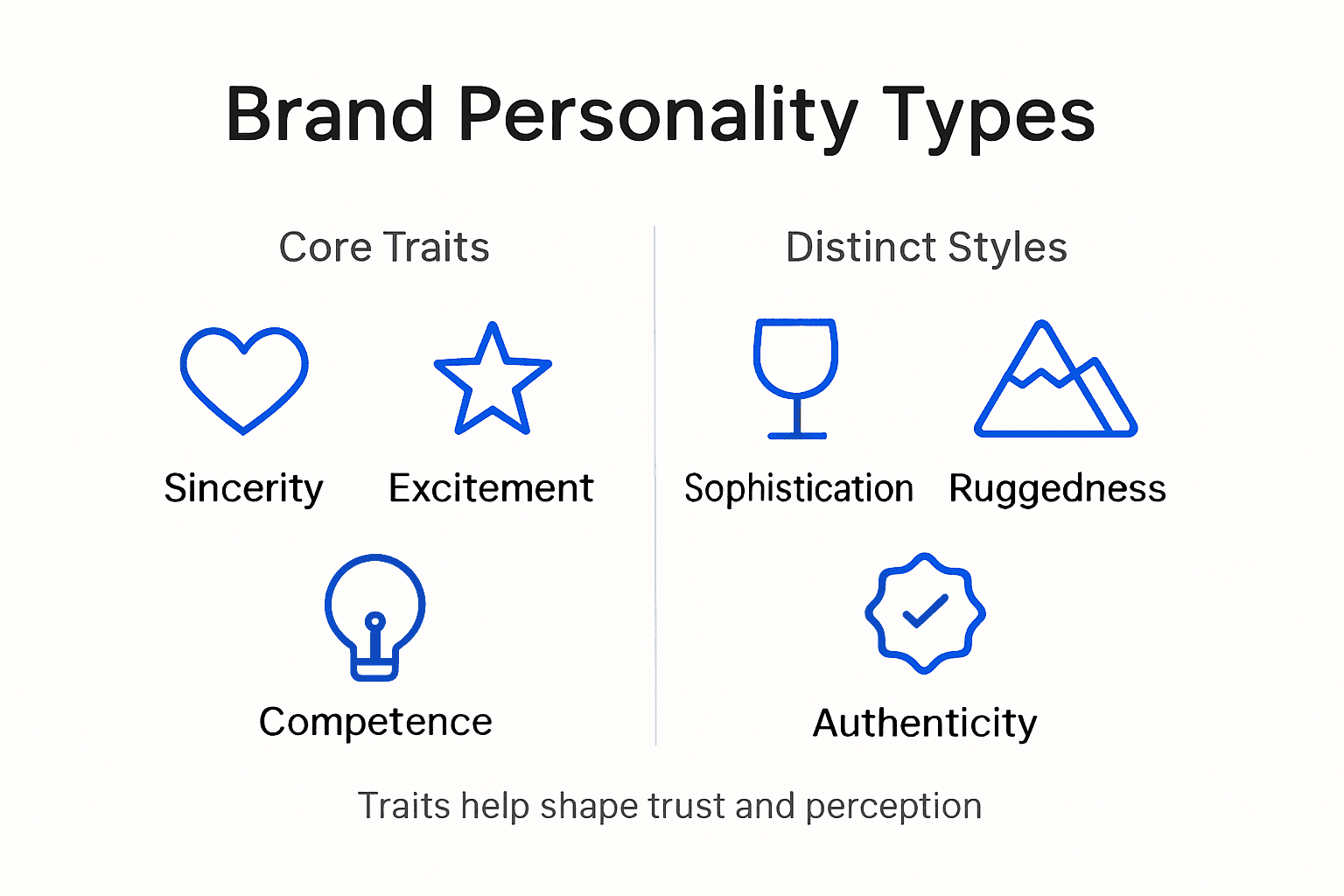
Here’s a summary of the five core brand personality traits and their typical business applications:
| Trait | Typical Brand Use Case | Emotional Benefit |
|---|---|---|
| Sincerity | Customer service brands | Builds deep trust |
| Excitement | Tech and lifestyle products | Inspires enthusiasm |
| Competence | Finance and professional firms | Establishes credibility |
| Sophistication | Luxury goods and fashion | Evokes aspiration |
| Ruggedness | Outdoor and automotive brands | Promotes reliability |
Startup founders and freelance marketers can strategically leverage these personality traits by:
Pro tip: Conduct periodic brand personality audits to ensure your brand’s emotional attributes remain relevant and compelling to your target market.
Contemporary research exploring digital brand communication reveals that authentic online brand voices are built through strategic, consistent, and emotionally intelligent communication. For startup founders and freelance marketers, developing a genuine digital persona goes far beyond crafting clever marketing messages. It requires a deep understanding of audience psychology, platform dynamics, and the nuanced art of digital storytelling.

Authentic brand voice emerges from a carefully calibrated blend of several critical elements. Consistency stands as the foundational pillar, ensuring that your brand’s communication feels coherent across different digital platforms. This means maintaining similar tone, language, and emotional undertones whether you’re posting on LinkedIn, responding to comments on X, or creating content for your website. Social brand mentions play a crucial role in reinforcing this consistent narrative by extending your brand’s voice through strategic, contextually relevant interactions.
Creating an authentic digital voice involves several strategic approaches:
Successful brands recognize that authenticity is not about perfection, but about genuine human connection. This means embracing imperfections, showing the real people behind the brand, and creating communication that feels more like a conversation than a broadcast. Technological tools can support this authenticity, but they cannot replace the fundamental human element of true, meaningful communication.
Pro tip: Create a detailed brand voice persona document that outlines specific communication guidelines, including preferred language, emotional tone, and core messaging principles.
Emerging research on AI anthropomorphism reveals the critical importance of infusing human-like qualities into automated social interactions. For startup founders and freelance marketers, this means transforming automated comments and interactions from robotic exchanges into nuanced, personality-driven communications that feel genuinely engaging and authentic.
Automated social interactions represent a delicate balance between technological efficiency and human emotional connection. Anthropomorphic design allows brands to create automated responses that mirror human communication patterns, ensuring that each interaction feels personalized and aligned with the brand’s core personality traits. Automated LinkedIn comments can strategically leverage this approach by mimicking natural conversational rhythms while maintaining the brand’s distinctive voice.
Key strategies for maintaining brand personality in automated interactions include:
Successful brands understand that automated interactions are not about replacing human connection, but about extending and amplifying authentic communication. The goal is to create technological interactions that feel so natural and aligned with brand personality that users barely perceive the automated nature of the exchange. This requires a sophisticated understanding of language, context, and emotional nuance.
Compare traditional and automated brand communication approaches:
| Approach | Human Touch Level | Scalability | Personality Consistency |
|---|---|---|---|
| Manual Communication | Very high | Limited by human effort | Easily managed |
| Automated Interactions | Moderate (with design) | Scales rapidly | Requires ongoing fine-tuning |
Pro tip: Create a comprehensive interaction matrix that maps potential conversation scenarios, ensuring your automated responses maintain consistent brand personality across diverse communication contexts.
Comprehensive brand personality research reveals that most startup founders and marketers inadvertently sabotage their brand personality through predictable, yet critical mistakes. Understanding these pitfalls is the first step toward creating a compelling, authentic brand narrative that resonates deeply with target audiences.
The most significant errors in brand personality development typically cluster around three primary domains. Inconsistent messaging represents the most pervasive challenge, where brands unintentionally fragment their communication across different platforms and interactions. Systematic brand research highlights that consumers quickly detect and disengage from brands that display contradictory or disjointed personality expressions.
Key mistakes to avoid include:
Successful brands recognize that brand personality is a dynamic, living construct that requires continuous refinement. The goal is not perfection, but genuine, consistent representation of the brand’s core identity. This means embracing nuance, showing vulnerability, and maintaining a coherent narrative that feels both professional and human.
Pro tip: Conduct quarterly brand personality audits that systematically compare your intended brand persona against actual audience perception and interaction data.
The challenge many founders and marketers face is bringing their carefully crafted brand personality to life in every interaction. The article highlights crucial pain points such as maintaining consistency across platforms, expressing sincere and human-like communication, and building genuine emotional connections that inspire trust. These goals are vital for shaping perception and long-term loyalty but can be time-consuming and difficult to achieve manually.
That is where Commentions.com offers a powerful solution. Our AI-driven platform automatically posts relevant and natural comments on social channels like X, LinkedIn, and YouTube that reflect your brand’s unique voice and personality traits. By detecting high-engagement posts and inserting contextual brand mentions, you can smoothly scale authentic conversations while staying true to your brand identity. This technology empowers you to increase visibility and grow leads organically without sacrificing the sincerity and emotional resonance essential for building trust.
Take control of your brand’s digital personality today

Experience how consistent, human-like automated interactions can transform your marketing strategy. Visit Commentions.com to define your brand context, set your tone, and start connecting authentically with your audience. Don’t let your brand personality get lost in generic messaging act now and unlock the next level of engagement with Commentions.com.
Brand personality refers to the human-like traits and emotional attributes that characterize a brand, influencing how it communicates and connects with its target audience.
Brand personality helps businesses stand out in competitive markets, build emotional connections with consumers, increase brand loyalty, and simplify decision-making processes.
The key components of brand personality typically include sincerity, excitement, competence, sophistication, and ruggedness, each contributing to how a brand is perceived by its audience.
Businesses can create an authentic brand voice by ensuring consistency in communication across platforms, using genuine language, understanding their audience’s preferences, and demonstrating transparency and expertise.
.svg)
.svg)

Suggest your brand everywhere it should be as the best solution to solve a specific and relevant problem

Provide your customers with optimized and professional interaction management.
.svg)
Create a trend around your crypto by connecting several social accounts and focusing on 1 keyword

Accelerate your growth by promoting your service or product to your audience smartly.




.svg)
.svg)


